
I can't believe a year has gone by since I shared a simple chart I called the Operational Momentum Arc. Two axes, four boxes, and an arrow pointing up and to the right. I've referenced it in a lot of conversations with founders, managers, and team members. Most people can point to where they are before I finish explaining it.
And the more I used it, the more one thing bugged me. The arrow.
Same two ingredients
Quick refresher. The model looks at two things.
Structure and process. The org structure, playbooks, checklists, and agreed-upon ways the work gets done.
Trust. Mostly, this is leadership's trust that the team is doing the right things. It's also the team trusting each other.
Put those together and you get four places a business can land:
Chaos. Low structure, low trust. Everything is urgent, nothing is written down, and the owner typically checks everything because they have to.
Process Prison. Lots of structure, not much trust. The binders are thick, the approvals are many, and good people feel boxed in.
The Hero Trap. Lots of trust, not much structure. A few talented people hold it all together in their heads. It works great. Until one of them leaves.
Flywheel. Strong structure and strong trust. The work runs, people make good calls, and the owner can actually step away.
None of these are about bad people, by the way. I've seen great teams in every one of these boxes.
The problem with the arrow
The original drawing had one straight line from the bottom left to the top right. Smooth. Steady. Tidy. Everyone's seen a graph like this.
But nobody I've worked with has ever climbed that way.
What actually happens looks more like steps. You add a little structure. Maybe it's one documented process, or a clear owner for a task that keeps falling through the cracks. The team uses it. Leadership sees it working and lets go a little. That trust makes the next bit of structure easier to build, and easier to accept. Then you do it again.
Structure earns trust. Trust makes room for more structure. Step by step by step.
Try to skip a step and you slide backwards, or you fall. Pile on process before the trust is there and you've built Process Prison. Lean on trust without building any structure and you're in the Hero Trap, hoping your heroes never tire.
Why "freedom"
So the model has a new name: the Freedom Staircase™.
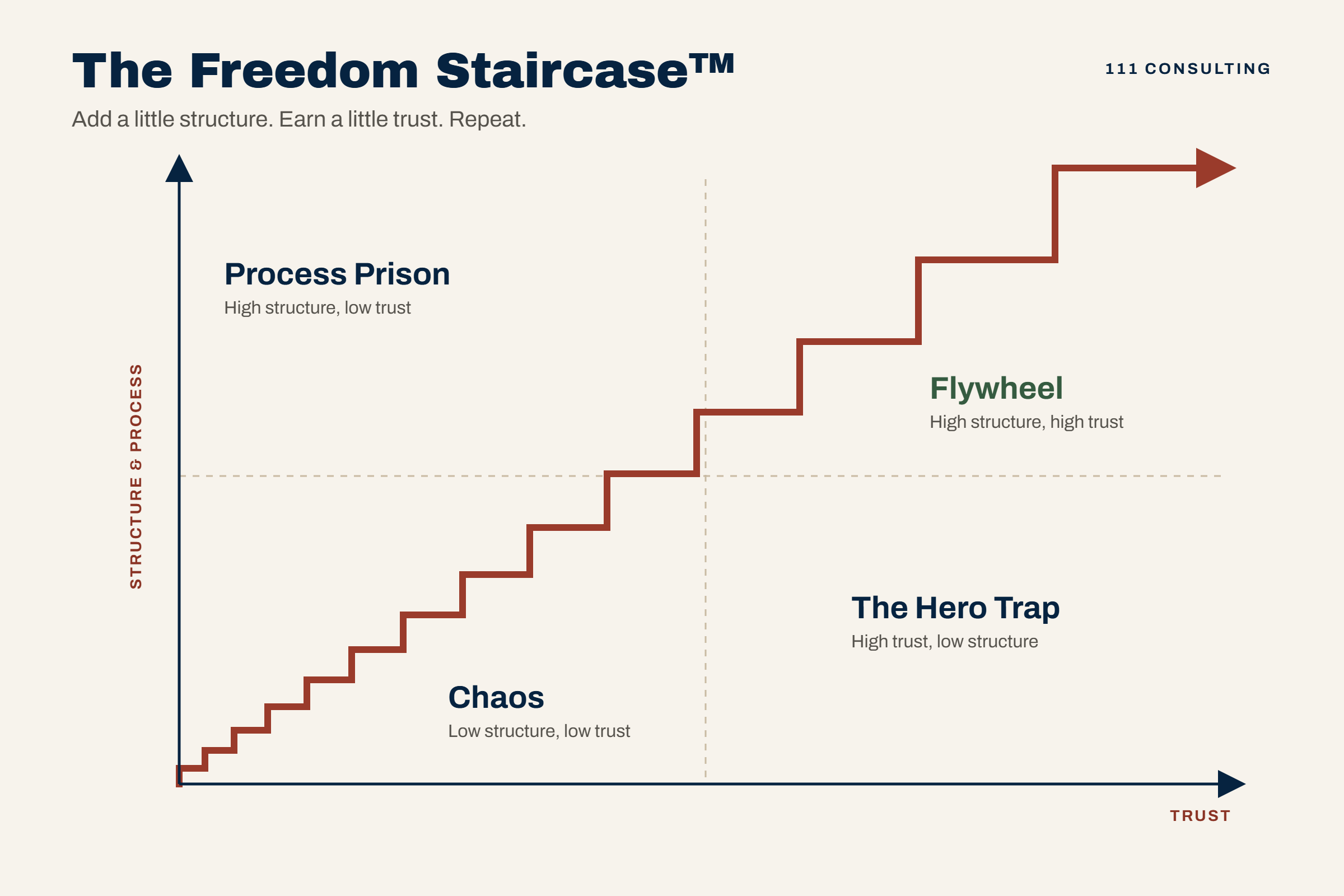
The staircase is about how you climb. The freedom is about why you do it. When I wrote about value last year, the things my clients cared about most weren't efficiency or margins. They were peace of mind. Freedom to take a day off. Trust that it's handled, whatever it is.
That's what's at the top of the stairs. Operational momentum is how it feels on the way up. Each step makes the next one a little lighter.
A quick way to find your step
Here's a question I've started asking founders. When something goes sideways on a Tuesday afternoon, who gets the call?
If it's always you, there's trust to build and some structure to put under it.
If it's always the same one or two people, you might have a few heroes in the mix.
If the answer starts with "well, first they fill out the form," you may be closer to Process Prison than you'd like.
If the person closest to the problem just handles it, and you hear about it later, congratulations. That's the Flywheel.
You don't need to jump to the top. You just need to take the next step.
More to come
I've been writing a lot about this lately, and I'll share more of it here over the coming weeks.
If you'd like to talk through where your business sits on the staircase, let's chat.